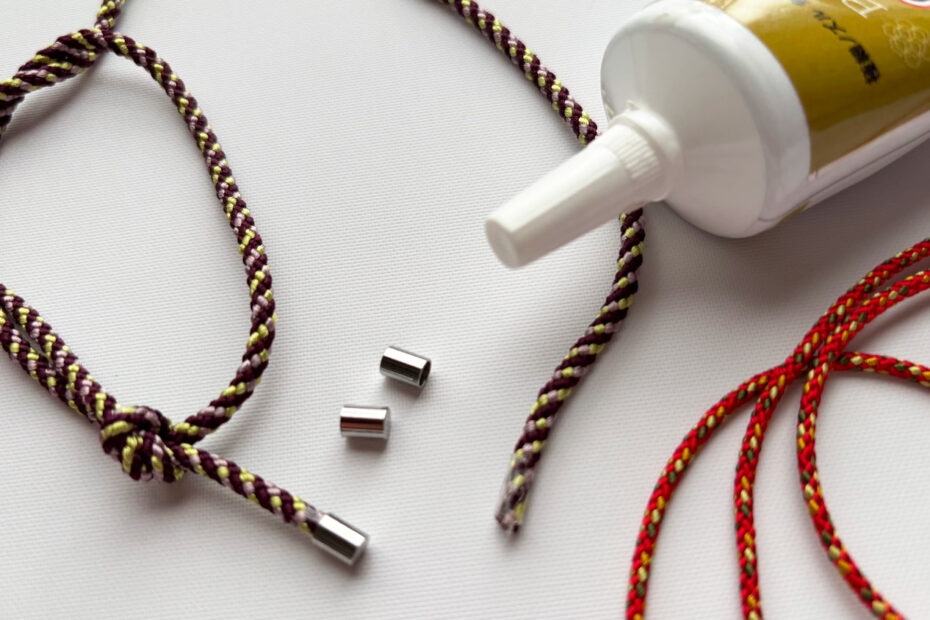
Why Adhesive Choice Matters in Silk Jewelry
Silk is a natural protein fibre, and it reacts differently to adhesives compared to synthetic cords such as polyester or nylon. Using an inappropriate glue may weaken the fibres, cause stiffness at the ends, or lead to long-term bond failure—issues that are especially problematic in fine jewelry.
Because silk is often chosen for its softness, drape, and refined appearance, the adhesive used at the end caps is crucial to maintaining both durability and aesthetics. Selecting the right adhesive helps preserve the silk’s natural character while ensuring a secure, professional finish.
Discover the best adhesive for silk cord to enhance durability and achieve a clean, professional result in your jewelry-making projects.
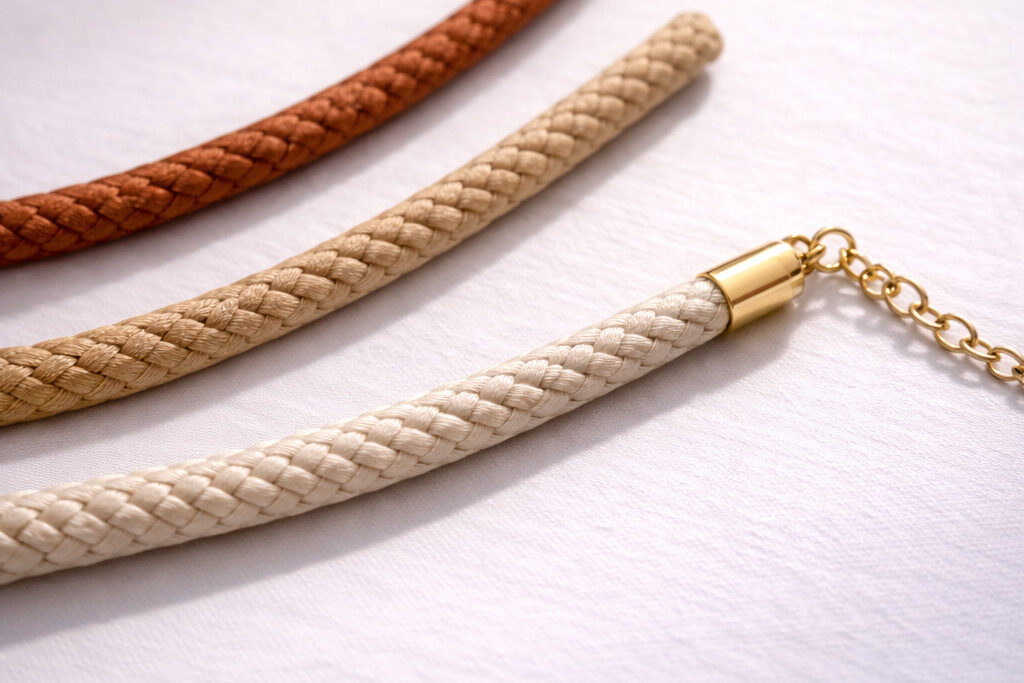
Jewelry Makers’ Guide to Bonding Silk to Metal
Choosing the right adhesive for silk cord and 18k gold end caps is essential for long-lasting jewelry. Unlike synthetic cords, silk fibres can absorb adhesives unevenly, which makes both adhesive choice and application technique particularly important.
This article explains commonly used jewelry adhesives for silk-to-metal bonding, based on standard practices among jewelry makers. It is intended as a general reference rather than a guarantee for a specific outcome.
What Is the Best Glue for Silk Cord and Metal End Caps?
There is no single “perfect” glue for every situation. Instead, several adhesives are commonly used in jewelry making, depending on factors such as cord thickness, end cap design, and the intended wear of the finished piece.
Below are the most frequently used options.
1. T-8000 Jewelry Adhesive for Silk and Metal
T-8000 adhesive is frequently used in jewelry and textile-based designs.
- Suitable for silk cords and metal end caps
- Dries clear
- Provides a slightly flexible bond
- Easy to control in small spaces
Many jewelry makers prefer T-8000 when working with fine silk cords and lightweight end caps, as it allows for precise application without excessive seepage.
2. E6000 Adhesive for Silk Cord Jewelry
E6000 is one of the most widely used adhesives in jewelry making.
- Strong adhesion to metal
- Works well with fabric and silk
- Flexible after curing
- Resistant to moisture and everyday wear
Because of its flexibility, E6000 is often chosen for necklaces and bracelets that experience regular movement during wear.
3. Two-Part Epoxy for 18K Gold End Caps
For maximum strength, some jewelry makers use a clear two-part epoxy.
- Excellent bonding to precious metals
- Strong, permanent adhesion
- Best suited for solid 18k gold end caps
Since epoxy cures rigidly, it should be applied in very small amounts and tested on a sample before final assembly, especially when working with delicate silk fibres.
How to Prepare Silk Cord and End Caps Before Gluing
Proper preparation significantly improves bond strength, regardless of adhesive choice.
- Clean the inside of the end cap with isopropyl alcohol to remove oils
- Lightly roughen the interior surface to improve adhesion
- Apply adhesive deep inside the cap rather than only at the opening
- Insert the silk cord slowly, allowing fibres to absorb the adhesive
- Avoid excess glue to keep the visible silk clean
These steps are commonly used by professional jewelry makers to improve durability and finish quality.
Additional Tip for Preventing Silk Cord from Unraveling
When cutting a long silk cord, the braid may begin to loosen at the cut end if it is left unsecured.
A simple way to prevent this is to wrap a small piece of tape around the cutting point before trimming the cord. Another method, especially when preparing the cord for an end cap, is to apply a small amount of diluted water-based glue to the tip first, let it dry, and then cut the cord cleanly. Lightly stiffening the end in advance can help maintain the braid structure and make it easier to insert into the cap.
These small preparation steps can improve both handling and finishing accuracy.
Which Adhesive Should You Choose?
- For flexibility and ease of use → T-8000 or E6000
- For the strongest long-term hold → Clear two-part epoxy
- For fine jewelry → Combine adhesive bonding with precise end-cap fitting
Testing different adhesives on a small sample is a standard practice before final production.
Professional Guide: Finishing Silk Kumihimo Cords with End Caps
Jewelry makers often ask how to properly finish silk kumihimo cords so that the ends remain secure, clean, and durable.
Below are practical recommendations commonly used in jewelry studios.
1. Recommended Materials for End Caps
The most common end-cap materials used with silk kumihimo cords are:
• Sterling silver (925)
• Gold-filled
• 18K gold for fine jewelry
• High-quality brass with durable plating
The most important factor is fit.
The inner diameter of the end cap should be slightly larger than the cord diameter, typically allowing about 0.1–0.2 mm clearance.
This allows adhesive to spread evenly without compressing the braid structure.
2. Best Practices for a Clean and Durable Finish
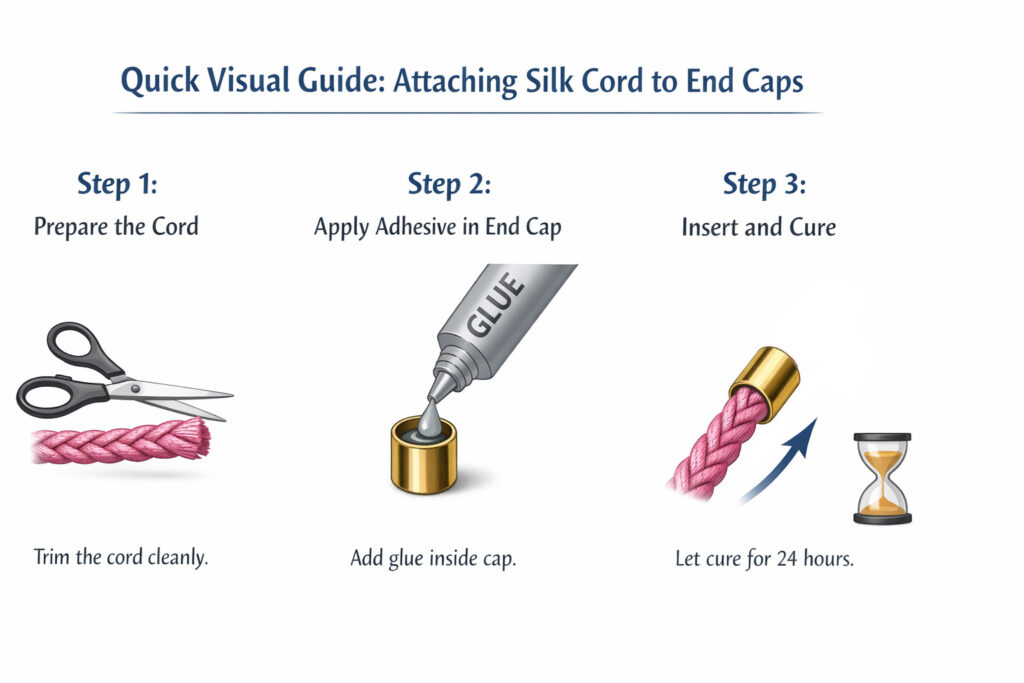
Professional jewelry makers typically follow these steps:
- Trim the cord cleanly with sharp scissors.
- Clean the inside of the end cap with alcohol.
- Apply adhesive inside the end cap rather than directly on the cord.
- Insert the cord slowly while rotating slightly.
- Remove excess adhesive immediately.
- Allow the adhesive to cure fully (usually 24 hours).
This method helps maintain both the appearance of the silk and the structural strength of the bond.
3. Testing Before Final Assembly
Because cord structure, metal finish, and environmental conditions vary, professional jewelry makers usually test adhesives before final assembly.
Recommended testing steps:
• Apply adhesive to a short sample of cord
• Insert it into a spare end cap
• Allow full curing time
• Perform a gentle pull test
Environmental factors such as humidity, temperature, and metal plating can influence adhesion results.
For this reason, the final selection of adhesive and finishing technique remains the responsibility of the jewelry maker.
Proper testing ensures both durability and a clean professional finish.
Choosing the Correct End Cap Size for Silk Kumihimo
Selecting the correct end cap size is just as important as choosing the adhesive.
If the end cap is too tight, the braided structure of the silk cord may be compressed or distorted.
If it is too loose, the adhesive bond may become weak.
As a general guideline used in jewelry making:
• The inner diameter of the end cap should be 0.1–0.2 mm larger than the cord diameter.
Examples:
• 1.0 mm silk cord → 1.1–1.2 mm inner diameter end cap
• 1.5 mm silk cord → 1.6–1.7 mm inner diameter end cap
• 2.0 mm silk cord → 2.1–2.2 mm inner diameter end cap
This small clearance allows the adhesive to distribute evenly inside the cap while keeping the braid structure intact.
When working with very soft silk cords, slightly deeper end caps are often preferred, as they provide more bonding surface and improve durability.
Testing with sample pieces is always recommended before assembling finished jewelry.
Important Note on Kumihimo Cord Diameter
Unlike metal wire or leather cords, kumihimo cords are braided structures made from multiple threads.
Because of this structure, the diameter of the cord can change slightly depending on tension, handling, and humidity.
For example:
• The cord may compress slightly when inserted into an end cap
• The braid may expand when the tension is released
• Natural silk fibres may respond to environmental humidity
For this reason, the stated cord diameter should be considered an approximate reference rather than a rigid measurement.
Jewelry makers are encouraged to test the fit between the cord and the end cap before final assembly, especially when working with fine silk kumihimo.
This characteristic is part of the flexibility and softness that makes kumihimo cords well suited for jewelry design.
Choosing the Right Adhesive for Silk Cord Jewelry
In professional jewelry making, durability usually comes from a combination of adhesive bonding and proper mechanical fit.
Adhesive alone should not be relied upon if the end cap is significantly larger than the cord.
Likewise, a perfectly tight cap without adhesive may loosen over time.
A reliable finish typically combines both factors:
• A well-sized end cap that fits the cord with minimal clearance
• A small amount of flexible adhesive is applied inside the cap
• Adequate curing time before the jewelry is worn
This approach allows the adhesive to secure the fibres while the end cap itself provides structural support.
Many professional jewelry makers consider the fit of the end cap just as important as the adhesive used.
Final Thoughts
When attaching silk cords to 18k gold end caps, adhesive choice depends on the silk structure, the end cap design, and how the jewelry will be worn. No adhesive works universally for every design.
This guide is provided as a general reference, reflecting commonly used techniques in jewelry production.
If you are selecting cords for jewelry design, the material itself also affects durability, flexibility, and finishing results.
For a deeper comparison between natural silk and modern Japanese silk-like fibres used in jewelry cords, see our detailed material guide.
FAQ|Silk Cord and Metal End Caps
Q. Can I use super glue for silk cord jewelry?
Super glue (cyanoacrylate) is generally not recommended for silk cords. It can make silk fibres brittle and may cause discoloration over time.
Q. Is epoxy better than jewelry glue for 18k gold end caps?
Epoxy provides the strongest bond, but it cures rigidly. Many jewelry makers choose T-8000 or E6000 for flexibility and epoxy for maximum strength.
Q. Do professional jewelry makers always use glue?
Many professionals combine adhesive bonding with a well-fitted end cap or mechanical support for added durability.
For Jewelry Designers Using Silk Cords
When working with high-quality silk cords, testing adhesives on a small sample is a common and recommended practice before final assembly, especially for custom or fine jewelry pieces