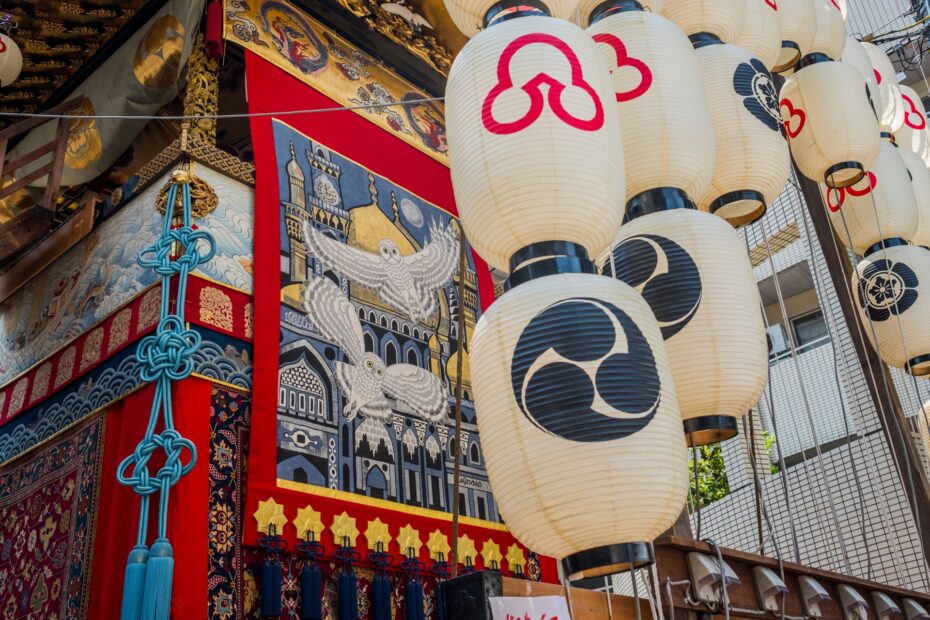
Every July, Kyoto turns its attention to the Gion Matsuri. Along Shijo-dori and Karasuma-dori, towering festival floats called yamahoko are paraded through the streets, each one dressed in carpets, tapestries, carved woodwork, and metal fittings so lavish that the procession is often called a “moving museum.”
As a shop devoted to kumihimo, traditional Japanese braided cord, there’s one detail we can never look past: the tasseled cords, or fusahimo, that hang from these floats. Today we’d like to share a little of the beauty and craftsmanship behind them.
The cords that hold the textiles together
Each yamahoko is dressed in an extraordinary set of hanging textiles — front panels, side panels, and back panels — collectively known as kensōhin. But it’s cord work that quietly does the job of hanging, securing, and finishing these textiles.
Originally, the textiles were tied on with small strips of cloth. Over time, decorative panels were added to hide these ties, eventually developing into the ornate lacquered rails that frame many floats today. Even in places visitors might not immediately notice, generations of craftspeople have layered detail upon detail to make the floats as beautiful as possible.
The tassels attached at the corners of a float are called kadobusa (“corner tassels”), and each float pairs them with its own distinctive metal fittings. On Tokusa-yama, for example, the hardware holding the corner tassels takes the shape of a war fan carried by a samurai general, with a silver rabbit worked into its rim. Even a single tassel, it turns out, is tied to the story and symbolism the float is built around.
When the cord itself takes center stage
Most of a float’s hanging textiles are woven or embroidered fabric, but on a few floats, braided cord itself becomes the centerpiece.
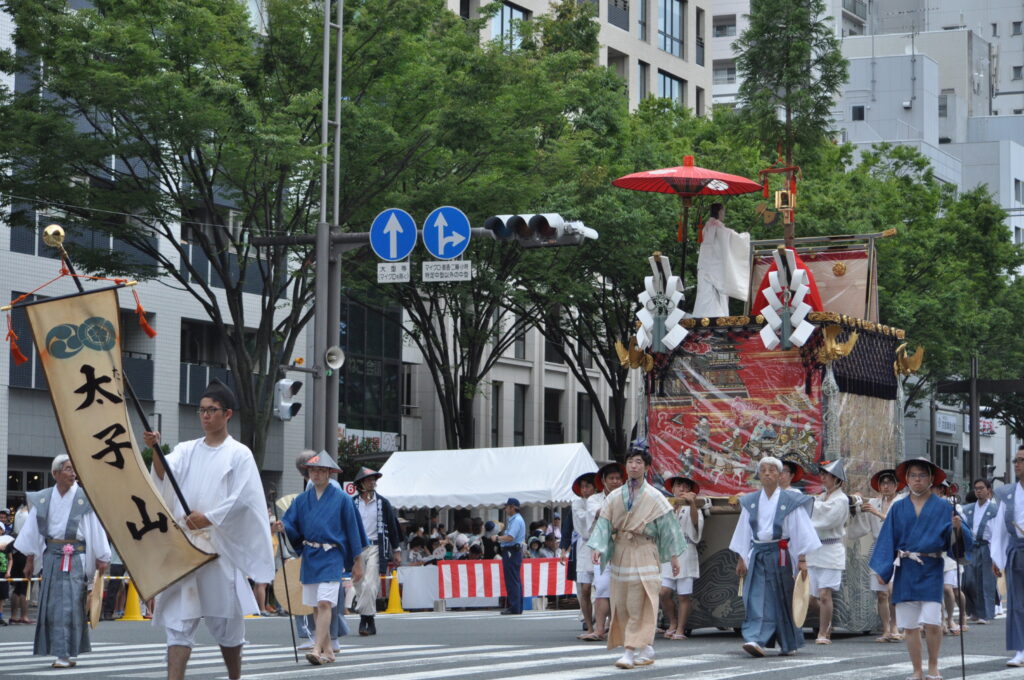
Taishi-yama is a wonderful example. While most floats use woven fabric for their mizuhiki (the valance-like textile hung along the top edge), Taishi-yama instead uses navy blue kumihimo braided into a shippō (interlocking-circle) pattern. Against the float’s gleaming gold side panels, that deep navy cord draws a crisp, elegant line — a real showcase for a braider’s skill.
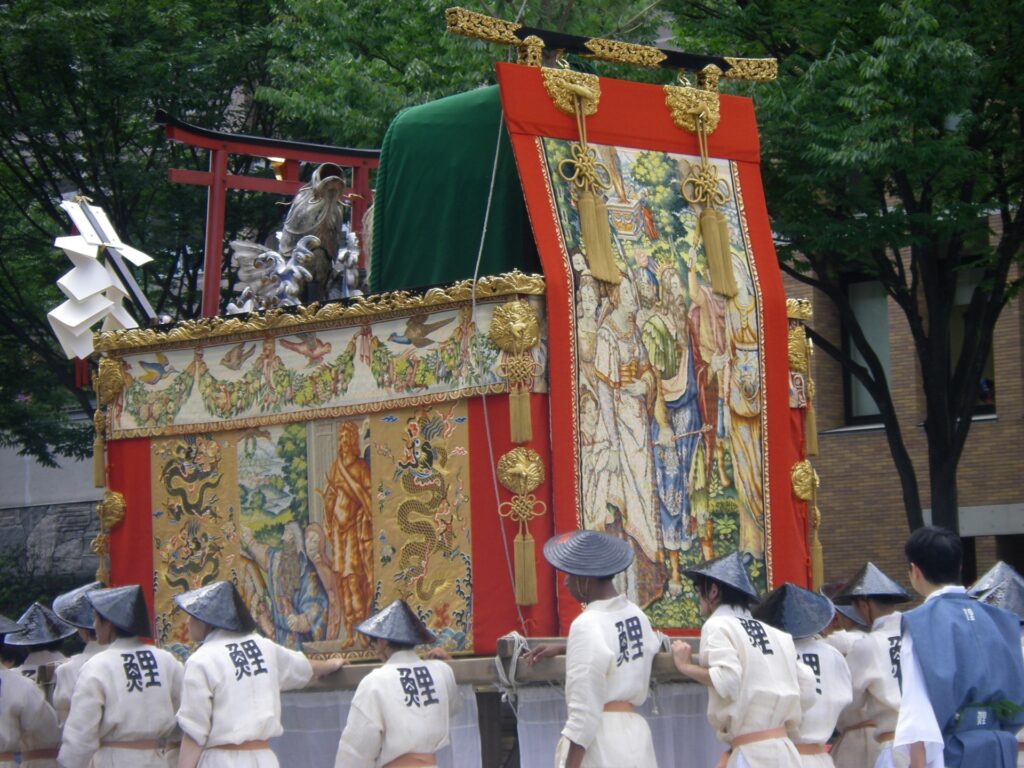
On Koi-yama, the float built around the legend of a carp climbing a waterfall to become a dragon, white hemp cords are hung to represent the waterfall itself. It’s a moment where fabric simply couldn’t do the job — only cord has the movement and texture to suggest falling water and the carp’s leap.
Even the knot carries meaning
Beyond the yamahoko, tassels tied in a particular knot — the agemaki musubi — appear throughout Japanese tradition: on shrine and temple curtains, on lanterns, even on the tassels marking the four corners of a sumo ring.
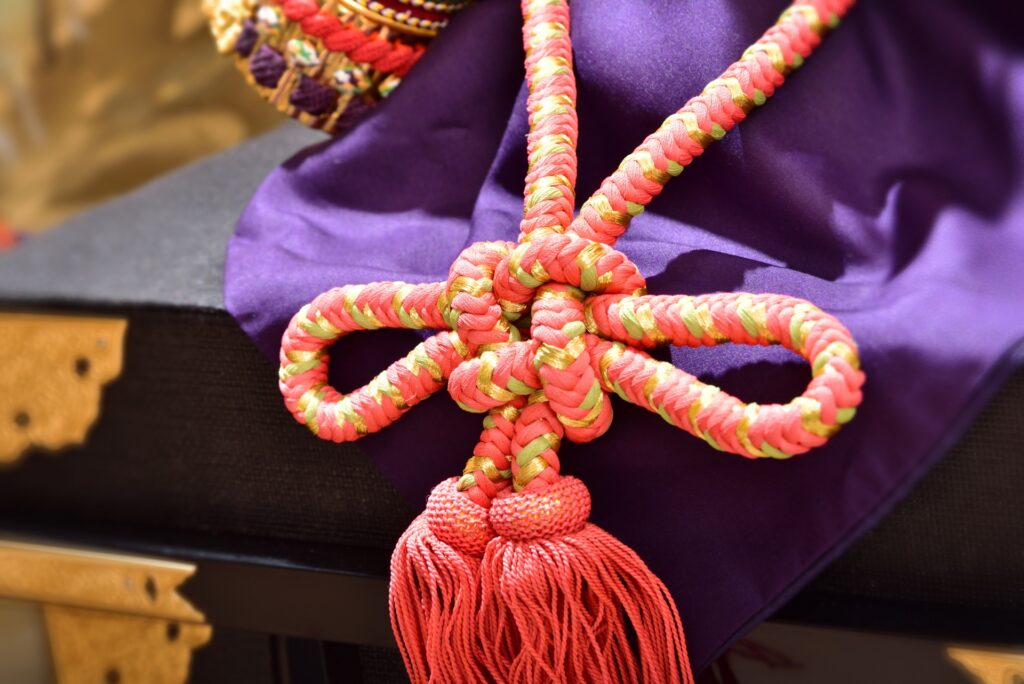
The agemaki knot is said to take its form from mizura, the looped hairstyle worn by young men in ancient Japan. Depending on how the central knot overlaps, it falls into one of two types — irigata, traditionally used for shrine furnishings, and hitogata, used on armor and helmets. In The Tale of Genji, the chapter titled “Agemaki” takes its name from this very knot, and a poem in that chapter ties the image of the knot to a wish for a lasting bond between two people. Long before it decorated a festival float, tying a tassel was already an act carrying hope and intention.
The craftspeople behind the cord
An Edo-period picture scroll cataloguing traditional trades includes an entry for the kumishi — the braided-cord maker. Using different types of stands (round stands, square stands, and tall stands, among others), a kumishi builds up a cord strand by strand, a process that has changed remarkably little since then.
The tasseled cords on Kyoto’s festival floats are a direct extension of that same handwork. That they still hang proudly alongside centuries-old carpets and tapestries is a quiet testament to how deeply the craft of kumihimo is woven into the fabric of this city.
In closing
It’s easy for the eye to go straight to a float’s carpets, tapestries, or gleaming metalwork. But next time you find yourself in front of a yamahoko, take a moment to look at the cords too — the sway of a corner tassel, the shape of a knot, the color of a braid.
If you’re in Kyoto for Gion Matsuri this summer, we hope you’ll notice them. It’s a small thing, but it carries centuries of craft behind it — and it’s the very same craft we work with here, every day.