Meaning, Symbolism, and Cultural Context
Silk kumihimo was not originally created for weddings.
It was braided for armor, for kimono, for objects that required both strength and beauty. Multiple threads were gathered and interlaced, forming a structure that held under tension.
Yet in its very structure lies a powerful metaphor for partnership.
What Kumihimo Represents
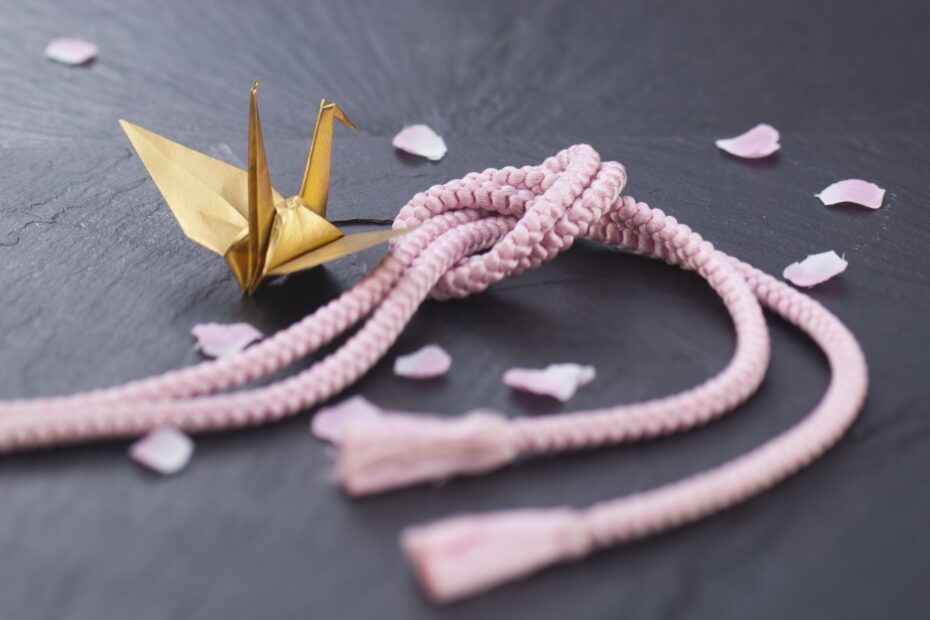
Kumihimo (組紐) literally means “gathered threads.”
Each strand remains visible. None disappears into the whole. Instead, strength emerges from interdependence.
Unlike a knot tied at a single point, kumihimo is continuous. Its unity is not created in one gesture, but through repeated crossings.
For couples seeking a symbolic act of commitment, this structure carries quiet resonance.
Silk as Material
Traditional kumihimo is braided from silk.
Silk has long been associated with refinement, ceremony, and care in Japanese culture. It responds to touch. It carries light differently from synthetic fibers. It softens with use.
In a ritual context, silk introduces texture and tactility — a material that feels alive rather than inert.
The material matters not because it is luxurious, but because it is responsive.
How Kumihimo May Be Used in a Ceremony
Kumihimo is not bound to one fixed ritual form.
Some possibilities include:
• Binding joined hands with a braided silk cord
• Tying each partner’s wrist with the ends of a single braid
• Creating a visible knot together during the ceremony
• Preparing a braided cord in advance as a shared symbol
The gesture matters more than the format.
In Japanese philosophy, musubu (結ぶ) refers to tying as a way of acknowledging connection. Kumihimo embodies this concept structurally.
It is not merely tied — it is woven.
Kumihimo in Relation to Other Traditions
Unlike mizuhiki, which is rooted in formal gift presentation and celebratory etiquette, kumihimo developed in functional and structural contexts.
Where mizuhiki expresses a moment of celebration, kumihimo expresses sustained interweaving.
For readers exploring the differences between these materials, see:
Mizuhiki vs Kumihimo: Differences, Meaning, and Use in Japanese Wedding Traditions
For a broader discussion of symbolic rituals beyond ring exchange, see:
Alternative Wedding Rituals Without Ring Exchange
A Ritual of Structure Rather Than Ornament
In many modern ceremonies, symbols are exchanged.
Kumihimo suggests something slightly different.
Instead of exchanging objects, partners may enact interweaving.
Instead of permanence represented by metal, continuity may be expressed through crossing threads.
The meaning does not lie in decoration.
It lies in structure.
A braid holds because each strand supports the others.
In that sense, silk kumihimo offers not a replacement for rings, but a different metaphor:
Not a circle of unbroken form,
but threads strengthened through relationship.
Frequently Asked Questions
Is kumihimo traditionally used in Japanese wedding ceremonies?
Historically, kumihimo was used in armor lacing, kimono accessories, and structural bindings rather than as a formal wedding ritual object. However, its symbolism of interwoven strands makes it meaningful in contemporary ceremonial interpretations.
What does kumihimo symbolize in a wedding context?
Kumihimo represents interdependence and structural unity. Multiple threads cross repeatedly to form a strong braid. In a symbolic context, this can reflect a partnership built through shared effort rather than a single moment of exchange.
Is silk important for a wedding ritual cord?
Silk is not required, but traditional silk kumihimo carries tactile and cultural depth. Silk responds to touch, softens over time, and has long been associated with ceremonial and refined contexts in Japan.
How is kumihimo different from mizuhiki in a wedding ceremony?
Mizuhiki is traditionally associated with formal gift presentation and celebratory etiquette. Kumihimo developed as a structural braid. In ritual terms, mizuhiki emphasizes decorative knot form, while kumihimo emphasizes sustained interweaving.
For a detailed comparison, see:
Mizuhiki vs Kumihimo: Differences, Meaning, and Use in Japanese Wedding Traditions
Can kumihimo replace the ring exchange in a wedding?
It does not “replace” the ring exchange in a traditional sense. Rather, it offers an alternative symbolic gesture. Some couples choose to enact a binding or tying ritual using braided silk cords to express commitment in a visible way.
Is using kumihimo in a ceremony culturally appropriate?
When approached with respect and understanding of its cultural context, kumihimo can be incorporated thoughtfully. Learning about its history and meaning helps ensure that the gesture is intentional rather than decorative.