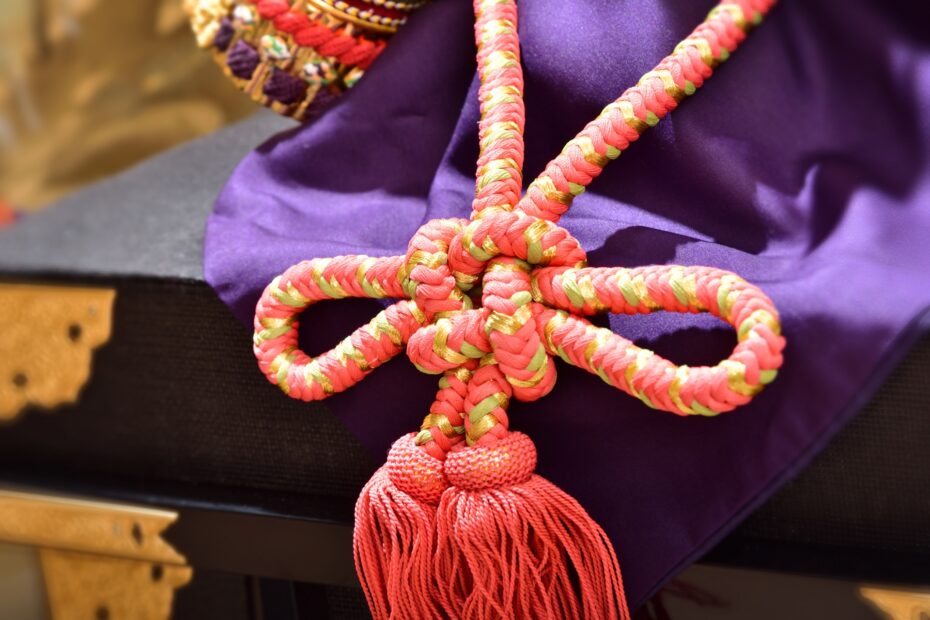
Binding, Knots, and Interwoven Connection in Japanese Culture
In Japanese, the verb musubu (結ぶ) means “to tie.”
Yet the meaning of musubu in Japanese culture extends far beyond knots and cords. It speaks to connection, relationship, and the act of making bonds visible through gesture.
To tie is to connect.
To bind is to acknowledge a relationship.
To interweave is to create strength through crossing.
Across Japanese ritual, craft, and material culture, the act of tying appears not as ornament, but as recognition.
Knot, Bind, and Interweave
In English, several words approach the meaning of musubu, yet none fully contain it.
A knot refers to a visible form — a specific shape created when a cord is tied.
To bind suggests the act of joining or holding together. When two lives are “bound,” the meaning extends beyond material fastening.
To interweave or interlace describes a structure formed through repeated crossings. Strength emerges gradually, not from a single point, but from sustained interaction.
Musubu can include all three.
It may describe a knot tied in a ceremony.
It may describe two people bound by a promise.
It may describe strands interwoven into a braid.
In this fluidity lies its cultural depth.
Musubu in Ceremony
In traditional Shinto weddings, ring exchange was never historically central. The emphasis lies in structured gestures — shared sake (san-san-kudo), spoken vows, and offerings made before the kami.
The ritual makes commitment visible through action rather than object.
For a deeper look at how Shinto weddings are structured, see:
→ https://ateliermiyabi.com/how-a-traditional-shinto-wedding-ceremony-works/
Across cultures, symbolic gestures replace or accompany ring exchange. Some couples today seek visible acts of connection rather than inherited forms.
You can explore these ideas further here:
→ https://ateliermiyabi.com/alternative-wedding-rituals/
Musubu in Material Culture
The philosophy of musubu is embedded in objects.
In decorative traditions such as mizuhiki, the knot itself carries meaning. The form marks celebration and acknowledgment.
For a detailed comparison between mizuhiki and braided cords, see:
→ https://ateliermiyabi.com/mizuhiki-vs-kumihimo-whats-the-difference-between-japans-traditional-ceremonial-cords/
In braided structures such as kumihimo, binding is not expressed in a single knot but through repeated crossings.
To explore how silk kumihimo may be used symbolically in ceremony, see:
→ https://ateliermiyabi.com/using-silk-kumihimo-for-wedding-rituals/