Learning Kumihimo Without a Teacher
Six Reliable Reference Books for Independent Study
Kumihimo is often described as a craft best learned through direct instruction.
However, for many people outside Japan, formal classes are not easily accessible.
For independent learners, the main challenge is not practice itself, but understanding structure:
why a braid behaves the way it does, how patterns are formed, and how colour, tension, and movement interact.
Below is a curated list of six reference books that have long supported independent study and research.
Each title links to a detailed product page with full specifications.
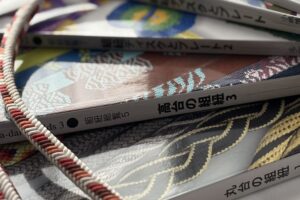
1. Marudai Kumihimo Vol. 1
This volume provides a systematic introduction to kumihimo made on the marudai.
It covers 120 braiding structures, from basic to advanced, with clear diagrams and colour examples.
For those beginning kumihimo without a teacher, this book offers the most reliable foundation.
2. Takadai Kumihimo Vol. 1 (Revised Edition)
This book introduces kumihimo made on the takadai, focusing on single-layer and basic double-layer structures.
Stand setup, hand movements, and braid logic are explained step by step.
It is particularly useful for learners encountering the takadai for the first time.
3. Takadai Kumihimo Vol. 2 (Revised Edition)
As a continuation of Volume 1, this book explores more complex constructions, including multi-tier and multi-layer braids.
Clear structural explanations help independent learners progress methodically rather than through trial and error.
4. Takadai Kumihimo Vol. 3
This advanced volume focuses on pattern drafting for double-layer braids, including Kōrai-gumi and Yasuda-gumi.
It introduces ayagaki (pattern charts), enabling readers to plan and design original patterns.
5. Kumihimo on the Takadai and Karagumi-dai
This visual reference book presents finished examples of takadai and karagumi-dai braids in multiple colour variations.
It is intended as a design and colour reference rather than a technical manual.
6. 2,500 Years of Kumihimo
This illustrated booklet traces the history of braided cords from ancient Andean examples to modern Japanese works.
Although not a technical guide, it provides valuable cultural and historical context for independent study.
The 2,500 Years of Kumihimo – More Than a Catalogue
When this book arrived, I expected a historical overview.
What I did not expect was the sense of awe.
Although presented as an exhibition catalogue, simply turning the pages is overwhelming. The reconstructed ancient braids — fragments recovered from temple sites and from the Shōsōin repository — reveal an extraordinary level of structural sophistication.
Kumihimo is inherently fragile. It was meant to be worn, tied, and used. Over centuries, it disappears. What survive are fragments — partial structures, traces of colour, small technical clues.
Unless someone studies those fragments and attempts reconstruction, entire techniques vanish.
The work presented here represents careful structural analysis and historically informed reconstruction. It reminds us that kumihimo is not only a craft, but an ongoing research field. The techniques we practice today exist because someone chose to study what remained and rebuild what was nearly lost.
For serious students of kumihimo, this book offers something rare: not instruction, but perspective.
Suggested reading order for self-study
- Marudai Kumihimo Vol. 1
- Takadai Kumihimo Vol. 1 → Vol. 2 → Vol. 3
- Kumihimo on the Takadai and Karagumi-dai
- 2,500 Years of Kumihimo
For learners studying kumihimo independently, these books function best as long-term references—resources to return to as understanding deepens.