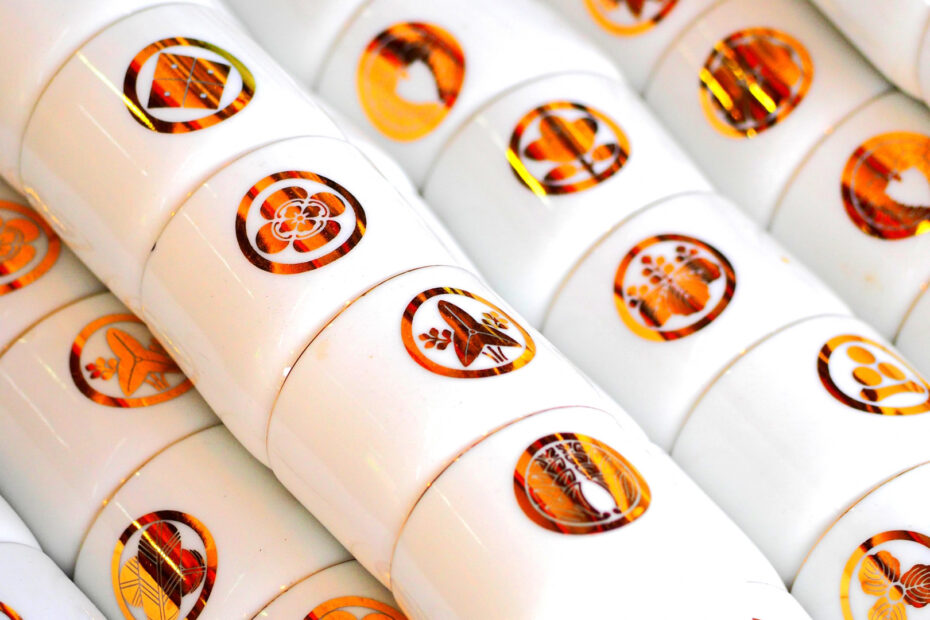
What Is Kamon? Japanese Family Crests Explained
Kamon are traditional Japanese family crests used to identify households through simple, symbolic designs.
Rather than displaying power or social rank, kamon express values such as clarity, balance, and continuity.
Unlike Western coats of arms, kamon are highly restrained. They rely on minimal forms, symmetry, and strong silhouettes, allowing them to remain recognisable across generations and materials.
To understand kamon properly, it is essential to look beyond the battlefield and into the quieter contexts of everyday life where they first emerged.
The Origins of Kamon in Everyday Japanese Life
Japanese family crests are often imagined as symbols used in warfare to distinguish allies from enemies.
In reality, their origins are far more understated.
From the late Heian to the Kamakura period, people in Japan began marking clothing, personal belongings, and household items with simple motifs. These marks helped identify ownership, organise daily life, and protect what mattered.
Early kamon designs were not created to impress.
They were created to function.
Motifs were chosen because they were familiar, easily recognisable, and culturally shared. What mattered was not decoration, but clarity.
The Meaning of Kamon Motifs
Plants, Nature, and Shared Understanding
Many early kamon feature plants such as pine, plum, wisteria, or paulownia.
These forms were deeply connected to daily life, seasonal awareness, and belief.
Rather than symbolising dominance or lineage, kamon condensed a household’s sense of value into a visual form.
They expressed what a family wished to preserve.
This is why kamon favour balance, symmetry, and generous use of space. They were designed to endure, not to follow fashion.
The Clove Motif (Chōji): Protection Without Display

Clove, known in Japanese as chōji, is now familiar as a spice. Historically, however, it held far greater meaning.
Chōji was valued for its fragrance, medicinal properties, and its ability to ward off impurity. It was used to scent garments, relieve pain, and protect the body. Its effectiveness was invisible, yet clearly felt.
This quality—being reliable without being conspicuous—aligns closely with long-held Japanese values.
When used as a kamon motif, the clove does not project strength outward.
Instead, it symbolises quiet protection, internal balance, and care.
It represents something relied upon when it truly matters, rather than something meant to be seen.
The Role of Circles in Kamon Design
What the Inner Circle (Chūrin) Represents
In kamon design, circles are never decorative by chance.
The chūrin, or inner circle, refers to a ring that encloses the central motif. Its purpose is not emphasis, but preservation. It defines a boundary in which meaning can remain intact.
In Japanese visual culture, circles often represent harmony and completeness. At the same time, they clearly distinguish inside from outside.
By enclosing the motif, the design gains calm and stability. The eye is guided naturally, and space is allowed to breathe.
This restrained structure reflects a design philosophy created for repetition and longevity.
What Kamon Reveal About Japanese Values Today
When we consider the origins of kamon, the symbolism of motifs such as clove, and the role of enclosing forms, a consistent message emerges.
Kamon do not seek attention.
They do not assert power or individuality.
Instead, they value what cannot be seen easily: internal balance, quiet effectiveness, and continuity over time.
This way of thinking continues to influence Japanese design today, from craftsmanship and textiles to packaging and visual identity. Meaning is preserved through structure, not display.
Kamon: Living Symbols, Not Relics
Japanese family crests are not relics of the past.
They embody a way of thinking that remains relevant in a world increasingly driven by excess and speed.
By prioritising restraint, clarity, and endurance, kamon remind us that lasting value does not need to be loud.
Their strength lies in continuity—and in the decision to protect meaning rather than broadcast it.
Frequently Asked Questions
What is the purpose of kamon in Japanese culture?
The purpose of kamon is identification rather than display. They help distinguish households while expressing shared values such as balance, restraint, and continuity.
Are kamon still used in modern Japan?
Yes. Kamon are still used today in ceremonial clothing, traditional crafts, packaging, and design. They continue to influence modern Japanese aesthetics and visual identity.