A Practical Perspective
Why Adjustable Closures Matter for Silk Cord Necklaces
When designing silk cord necklaces, the closure plays a critical role in both usability and longevity.
Silk is a beautiful and flexible material, but it is also sensitive to friction and pressure. For this reason, the choice of an adjustable finish is crucial. It can significantly affect how the piece looks. It also affects how it feels and performs over time.
A well-designed pendant can become difficult to use. This happens if the necklace is hard to adjust. It can also be uncomfortable to wear or prone to damage. In silk jewelry, the closure is a small detail with a large impact.
Silicone-Lined Slider Beads for Silk Cord Necklaces
A widely used modern solution is the silicone-lined slider bead.
This type of bead allows the wearer to easily adjust the necklace length. It does this without tying knots, while helping to reduce stress on the silk fibers. Its clean appearance and intuitive operation make it well-suited to contemporary jewelry design.
For many applications, this is a practical and efficient approach.
Traditional Bead Closures for Silk Cords in Japanese Craft
Adjusting silk cords with beads is not a new idea.
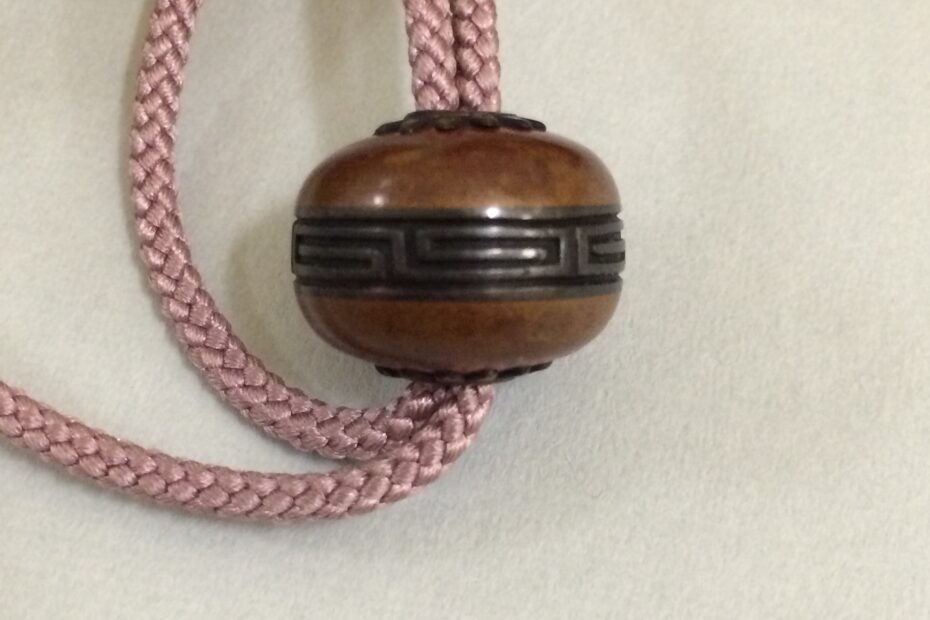
Traditional Japanese sliding bead used with silk cords.
Collection of the Metropolitan Museum of Art, New York.
Public Domain (Open Access).
In Japan, silk cords have historically been adjusted with bead-style movable stoppers, such as ojime used with inro. These beads were traditionally made from materials such as glass, wood, or ivory-like substances, depending on the period and purpose.
While the materials differ from modern slider beads, the underlying concept is the same: adjusting position without knotting.
For example, ojime beads are traditional Japanese sliding beads. They were once used with corded cases. They are part of the collection at the Metropolitan Museum of Art in New York. This collection illustrates the historical use of movable bead closures in silk and corded objects. https://www.metmuseum.org/art/collection/search/74108
It is also worth noting that Japan has a traditional silk bead form known as Odamaki. This form is made by winding silk thread into a compact, rounded shape.
While not intended as a modern adjustable mechanism, it reflects a long-standing appreciation for bead-like forms made from silk itself.
Silk Cord Thickness, Bead Hole Size, and Compatibility
One important practical consideration is compatibility.
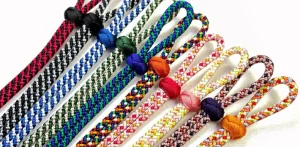
Cord thickness, bead hole size, material friction, and weight all influence performance. In particular, thicker silk cords—around 1.5 mm in diameter—do not fit or move smoothly through many standard or decorative slider beads.
For this reason, testing the intended cord-bead combination is essential. There is no single solution that works universally across all designs.
Our Approach to Silk Cord Finishing and Design Responsibility
We are happy to share knowledge about silk cord as a material. This includes its characteristics and historical context. We also outline both modern and traditional perspectives on adjustable closures.
Nevertheless, we do not offer technical finishing support or guarantees. Final decisions should always be made through testing within each specific design and usage context.
Choosing the Right Adjustable Closure for Silk Cord Jewelry
Use either a modern silicone-lined slider bead or a more traditional bead-based stopper method. The most important factor is that it respects the silk. It should also support the intended design.