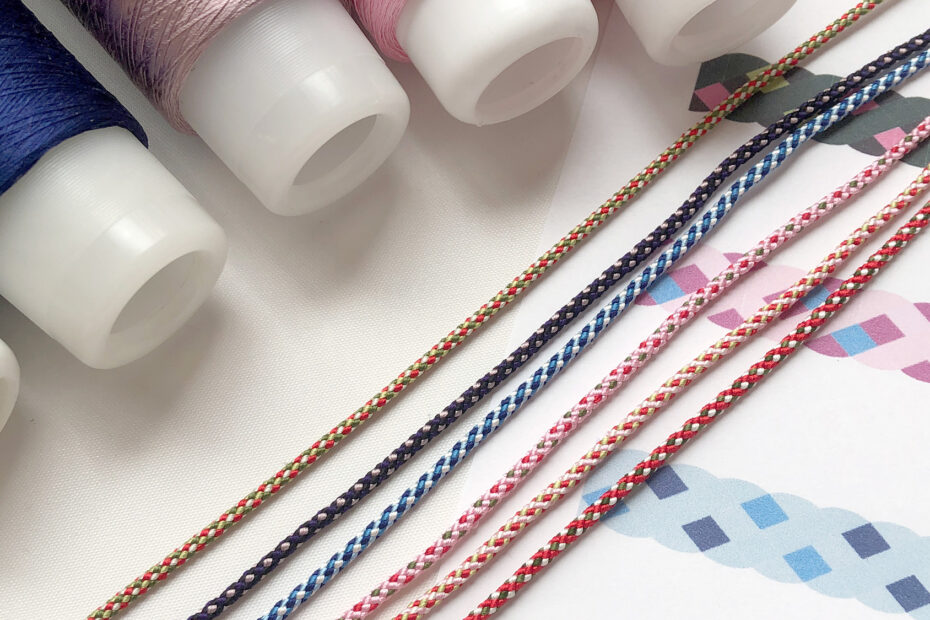
Choosing colors for a kumihimo cord is often more difficult than the braiding itself.
Each color looks beautiful on its own. Yet, the finished braid appears darker. It also seems busier or less balanced than expected.
This happens because kumihimo is not a flat surface.
Colors twist, overlap, and repeat in a spiral structure, changing how they are perceived once braided.
In this article, we’ll explore how color balance works in traditional 8-strand kumihimo (Yatsu-gumi). We will also discuss how to plan combinations that translate well into real braided cords.
Why Kumihimo Colors Look Different After Braiding
Unlike weaving or printing, kumihimo cords are formed by diagonal intersections.
Each strand appears and disappears as the braid rotates, which means:
・Light colors are be less dominant
・Dark colors often visually expand
・High-contrast combinations create a stronger spiral effect
This is why selecting colors purely from flat samples or swatches can be misleading.
Understanding the Main Color in Yatsu-gumi Braids
In an 8-strand spiral braid, not all colors behave equally.
One color naturally becomes the visual anchor of the spiral.
This main color defines the pattern’s rhythm and direction, while the others support it.
Practical guideline:
Choose one main color, then add
・one supporting color of similar brightness
・one lighter accent
・one darker stabiliser
This approach keeps the braid calm, readable, and intentional.
Common Mistakes When Choosing Kumihimo Colors
Some color combinations look appealing on screen but fail once braided.
Common mistakes include:
・Using four equally strong colors, resulting in visual noise
・Combining multiple dark tones without contrast
・Relying on silk shine instead of structural balance
Even with high-quality silk, structure matters more than material alone.
Previewing Color Balance Before Braiding
Because kumihimo patterns repeat continuously, previewing the spiral structure before braiding or ordering is extremely helpful. While the simulator supports four-color combinations, this is a design choice specific to the tool.
In traditional kumihimo, especially in classic Yatsu-gumi braids, cords are very often made using just two colors.
This is because two-color combinations produce the clearest and most visible spiral structure. This makes the braid’s rotational movement easy to read.
The simulator supports four colors. It can recreate traditional two-color spirals. It can also create dotted effects and alternating patterns that emerge from strand placement. By adjusting four color slots, it becomes possible to explore simple, traditional structures. You can also explore more complex variations within the same framework.
Using a visual simulator lets you:
・Select up to four colors
・Preview spiral and dotted effects instantly
・Adjust balance before committing to a design
If you want to experiment with color balance visually, you can try our online Kumihimo Color Simulator
here: https://ateliermiyabi.com/kumihimo-simulator/
This approach is especially useful for jewellery designers, custom orders, and limited-edition colour planning.
From Digital Preview to Real Silk Cords
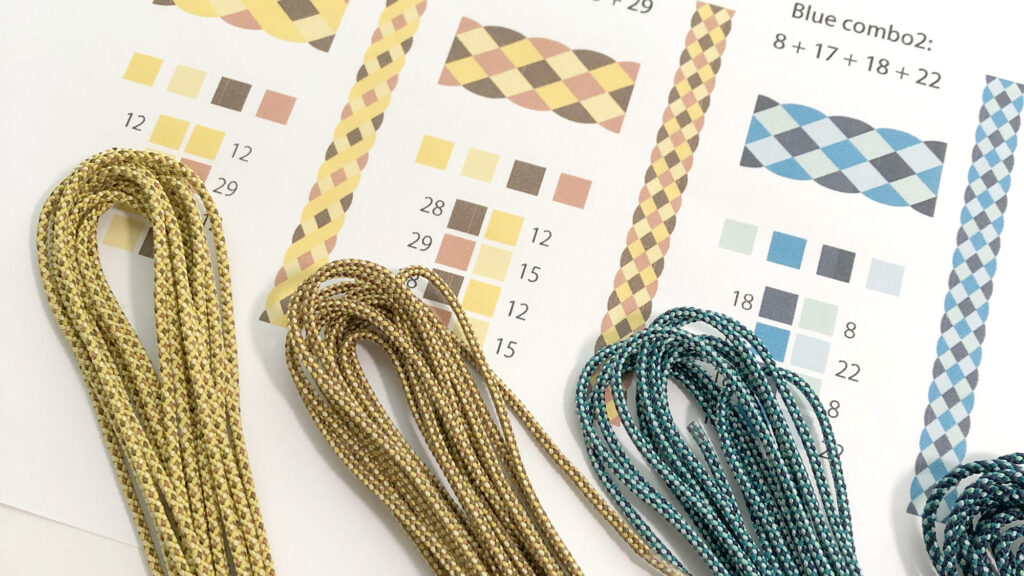
Digital color previews are always approximations.
Actual silk cords vary slightly depending on dye lots, lighting conditions, and the natural reflection of silk fibres.
Still, starting with a balanced structure greatly reduces the risk of unexpected results.
If you are unsure, discussing adjustments or requesting samples before a custom order is recommended.
Conclusion: Designing with Structure, Not Guesswork
Successful kumihimo color design relies less on intuition and more on understanding structure.
Recognise how colors rotate, dominate, and support each other within a braid. By doing this, you can create cords that feel refined, intentional, and timeless. This applies whether for jewellery, fashion, or traditional use.
Frequently Asked Questions About Kumihimo Color Selection
Q1. How many colors are traditionally used in kumihimo?
Traditionally, many kumihimo cords — especially classic Yatsu-gumi braids — are made using two colors.
Two-color combinations create the clearest, most visible spiral pattern, making the braid’s rotational structure easy to read.
Q2. Why does the simulator allow four colors if traditional kumihimo often uses two?
The four-color system is a design choice of the simulator itself.
The tool has four adjustable color slots. It can recreate traditional two-color spirals. It can also create dotted effects and alternating patterns that emerge from strand placement. This allows exploration of both classic and more complex variations within the same framework.
Q3. Is four-color kumihimo historically incorrect?
No. While two-color designs are very common in traditional kumihimo, using more colors is not incorrect.
The key is understanding how colors work within the braid. It is important to focus on the relationship between base colors and accent colors. This is more crucial than the number of colors alone.
Q4. Can I design kumihimo using only two or three colors in the simulator?
Yes. You can recreate two- or three-color designs by repeating the same color across multiple slots.
When doing so, clearly define a base color. You should also define an accent color. This helps keep clarity and balance in the finished braid.
Q5. Why do kumihimo colors look darker after braiding?
Because kumihimo cords are formed by diagonal overlaps, colors visually compress as they twist.
Dark tones are stronger, while light colors look less dominant than expected compared to flat samples.
Q6. Is there a “main color” in kumihimo patterns?
Yes. In spiral braids, one color naturally becomes the dominant visual anchor.
Choosing this main color intentionally helps create a calm, readable pattern rather than a chaotic mix.
Q7. Can I use four strong colors together?
You can, but the result is often visually busy.
For more refined designs, it’s recommended to combine one strong color with softer or neutral supporting tones.
Q8. How precise are the simulator’s color previews compared to real silk?
The simulator shows estimated digital colors and pattern balance.
Actual silk cords vary slightly depending on dye lots, lighting conditions, and the natural reflection of silk fibres. But, previewing the structure helps reduce unexpected results.
Q9. Who is the kumihimo color simulator most useful for?
The simulator is particularly useful for jewellery designers. It is also beneficial for makers planning custom cords. Anyone exploring color balance before braiding or ordering will find it useful.
It helps visualize spiral structure and pattern clarity before committing to materials.
For further reference on the history and traditional use of kumihimo, you may find these resources helpful:
Japan House Sao Paulo + Google Arts & Culture – Kumihimo Exhibition
https://artsandculture.google.com/story/kumihimo-the-art-of-japanese-silk-braiding-by-domyo-japan-house-sao-paulo/6AWxLo7Oc2YySA?hl=en
Japan House London – Kumihimo: Japanese Silk Braiding
https://www.japanhouselondon.uk/whats-on/kumihimo-japanese-silk-braiding-by-domyo/
。